WhatsApp

Position-Based Spreads with Lenormand: The Tarot-Style Method

alternative
INTRODUCTION

Petit Lenormand is traditionally read in lines or in large tables, a narrative method that can be confusing. If you come from the Tarot world, you are used to structured spreads with fixed "positions" (ex: Card 1 = The Past, Card 2 = The Future).

Can we apply these reassuring methods to Lenormand? YES, it is an excellent way to start to become familiar with the symbols without being overwhelmed by the complex geometry of the Grand Tableau.

The specific method: The Card Pair

Be careful though: Petit Lenormand is very polarized. Some cards are very positive (Sun), others very negative (Coffin). If you use one card only per position (as in Tarot), your answer may be too "brutal" or binary (All good or All bad).

My expert advice: For each position in your spread, draw two cards instead of one. This allows the cards to nuance each other (a "pair"). The interpretation then becomes more balanced, richer and less fatalistic.

Advice for beginners

Since we are doubling the cards, the total number on the table increases quickly. I advise you to initially limit yourself to spreads of 3 to 6 positions maximum (that is 6 to 12 cards). This is the ideal format to get precise answers without losing the thread of the story.

Discover below 5 exclusive spread models based on this "Paired Positions" method.
icone
NOTE
These spreads are perfectly suited for beginners in Petit Lenormand and those familiar with Tarot.
The idea of the spreads in this article is to follow the method of Tarot, adapted to Petit Lenormand, by offering 2-card positions. The "real" Lenormand spreads are more thoroughly explained in the series of 7 articles dedicated to learning Petit Lenormand, especially the article How to read Petit Lenormand.

Haut

Spread 1 : The love encounter

Spread 1 : The love encounter

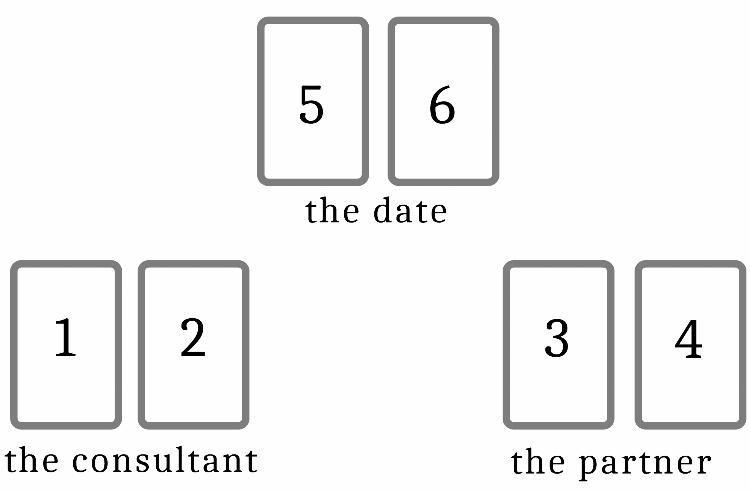
The spread takes place as follows :

  • First, the consultant draws two cards that represent him/her : his/her disposition, state of mind, openness and expectations of the meeting.
  • Then he/she draws two cards representing the person he/she has chosen, which will also indicate his/her expectations and behaviour in the meeting.
  • Finally the consultant draws two cards relating to the encounter itself. If he/she wants a predictive spread, the third pair of cards can represent the future of the encounter, how it will develop or end. If the consultant wants a psychological spread, the fifth and sixth cards can represent the psychological issues of the encounter, what the two partners will exchange, what they will build or not, how they will live the encounter and maybe even the lessons they will learn. The 5th and 6th cards can also represent advice to follow, allowing the relationship to progress with reason.
Haut

Spread 2 : The love dilemma

Spread 2 : The love dilemma

In this second love spread, I talk about the love dilemma, i.e. the choice between two people. The love triangle is actually quite common. Indeed, without necessarily speaking about a single person who has the choice between two suitors, even when we are in a couple, married or not, we sometimes meet a person who opens our mind to a possible love relationship. And then what should you do ? Leave your current partner ? Stay with him or her ? The answer often seems quite complex, as no one is perfect, and the ideal relationship does not exist. The spread takes place as follows:

  • First, the consultant draws two cards that represent him/her: his/her state of mind, doubts, expectations, dilemma. It is possible to assign each of the two cards to a partner, in order to clarify the consultant's perception of each partner.
  • Then the consultant draws two cards for one of the partners he/she has previously determined.
  • Finally he/she draws two new cards representing the other partner. The duos of cards about the partners evoke, like the consultant's, their state of mind, their expectations, their behaviour. The fortune teller guides the consultant to consider the psychological dimension of each partner in order to try to conclude on the most profitable and fulfilling relationship that he/she would develop with one or the other partner.
  • If this psychological spread is not enough, the consultant can draw two last cards which will represent a piece of advice to implement, or the result of the dilemma. I think that one should be careful not to draw these last two cards - which remain optional - too quickly, because it seems to me necessary to approach such a dilemma on a psychological and human level, with reason and lucidity. If the consultant is really lost, the 7th and 8th cards should represent a piece of advice, which he/she can take into account or not.
alternative
A free PDF to print, cut out, and fold!

Keywords for the 36 cards of the Petit Lenormand, to slip into your favorite deck. Your leaflet always with you, at hand, to guide you in your readings. Thanks to it, your interpretations gain in richness and subtlety.

Haut

spread 3 : The search for a job

spread 3 : The search for a job

This reading is not intended to tell the consultant if he/she will find a job. For this, I refer to my article on the YES/NO spread with the Petit Lenormand. Of course, the challenge of finding a job is major for the person, so I advise against making a binary reading in this kind of situation which can either discourage the consultant or make him/her too sure of him/herself and consequently negligent.

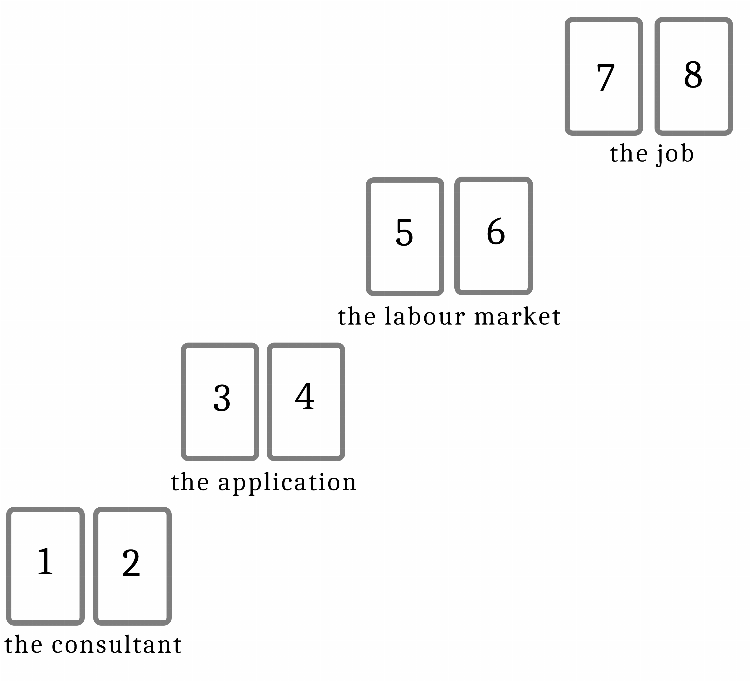
The aim of this spread is to draw up an exhaustive inventory that can be useful to the consultant and enable him/her to take relevant and positive action. The spread takes place as follows :

  • First, the consultant draws two cards that represent him/her : his/her doubts, expectations and whether he/she is in the right frame of mind for the job search.
  • Then the consultant draws two complementary cards representing his/her application : is his/her CV attractive ? does he/she present him/herself well in an interview ? is he/she smiling and convincing ? How do the recruiters perceive his/her application ?
  • The consultant draws two new cards about the labour market : Is it closed or gloomy ? What are the real opportunities ? Is there any competition ? Are the salaries interesting ? What kind of job : temporary work, seasonal work, fixed-term contract, permanent contract ?
  • Finally, the consultant draws two final cards on the job actually available to the consultant : Does it meet expectations ? Is it in the branch of activity in which the consultant is looking ? Does the consultant need to change direction ? Is it useful to do a skills assessment ? Is coaching or training necessary ?
Haut

Spread 4 : Resignation from your job

Spread 4 : Resignation from your job

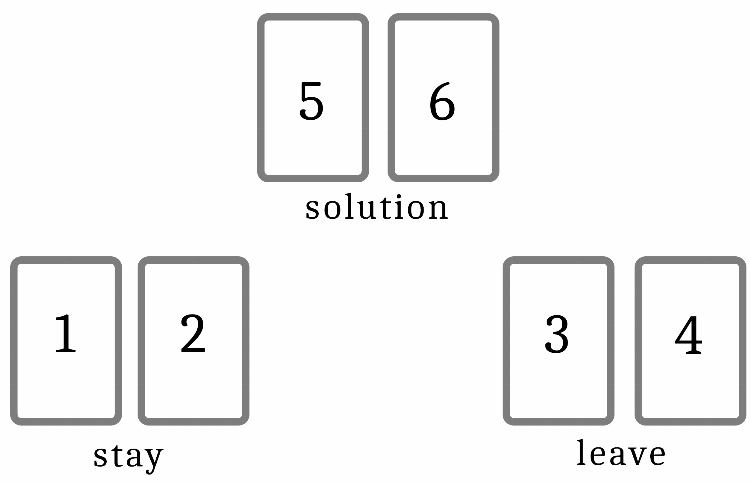
If finding a job can be difficult, changing jobs can be equally difficult. The consultant may not know what to do between staying in his or her current job despite the disadvantages or taking the risk of looking for or taking a new job, which may not be better or more interesting. This spread therefore proposes to reflect on the advantages and disadvantages of staying or leaving one's current job. The spread proceeds as follows :

  • First, the consultant draws two cards that represent the situation of staying in the current job : the conflict to be resolved, the compromise to be found, the stakes, the permanence of the position. It is possible to agree that one of the two cards should represent the advantages of staying and the other card should represent the disadvantages of staying.
  • Then the consultant draws two cards about the possibility of leaving the current job : the difficulty of finding a new job, the perils of moving into the unknown, the promises made by the recruiter or new employer, the viability of the proposed job. As with the first pair of cards, it can be agreed that one of the two cards can represent the advantages of leaving and the other card can represent the disadvantages of leaving.
  • Then the consultant draws two final cards on the result or advice to be applied. This pair may suggest a kind of compromise, or suggest another possibility, such as going into business for oneself, which the consultant had not considered. The result may be clear-cut, leave or stay, as well as ambiguous, inviting patience, mediation, counselling, or perhaps a change of position within the current company.
Haut

Spread 5 : The financial situation

Spread 5 : The financial situation

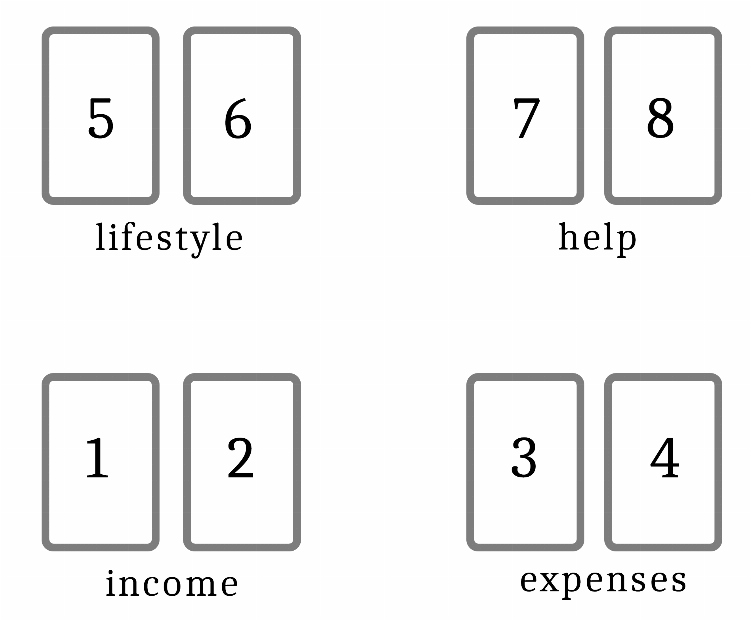
The consultant's financial situation may be delicate. He/she may be looking for ways to regain a serene and balanced situation. This spread proposes to review several aspects of the consultant's finances without focusing solely on the search for new sources of income. The spread proceeds as follows :

  • First, the consultant draws two cards to represent his or her income : is it sustainable or transitory ? Is an increase possible ? Is it possible to diversify ? Should the consultant change jobs ? Should he/she dip into his/her savings ? Should he/she sell assets ?
  • Then the consultant draws two cards for expenses : Can the reimbursements be deferred ? Should he/she share the expenses ? Should he/she look for a roommate ? Should he/she move to a cheaper flat ? Should he/she save on energy costs ?
  • The consultant draws two complementary cards about his/her lifestyle : Is he/she living beyond his/her means ? Does he/she need to be more frugal in his/her daily life ? Should he/she give up holidays, buy less clothes, renew his/her household appliances less often ?
  • The consultant draws two final cards about external help : Should he/she ask his/her family for one-off help ? Should he/she go to charity ? Should he/she seek advice on filling in tax returns in order to get tax reductions ? Can he/she obtain state aid ?
Haut

Bonus : The Cross Spread

Bonus : The Cross Spread

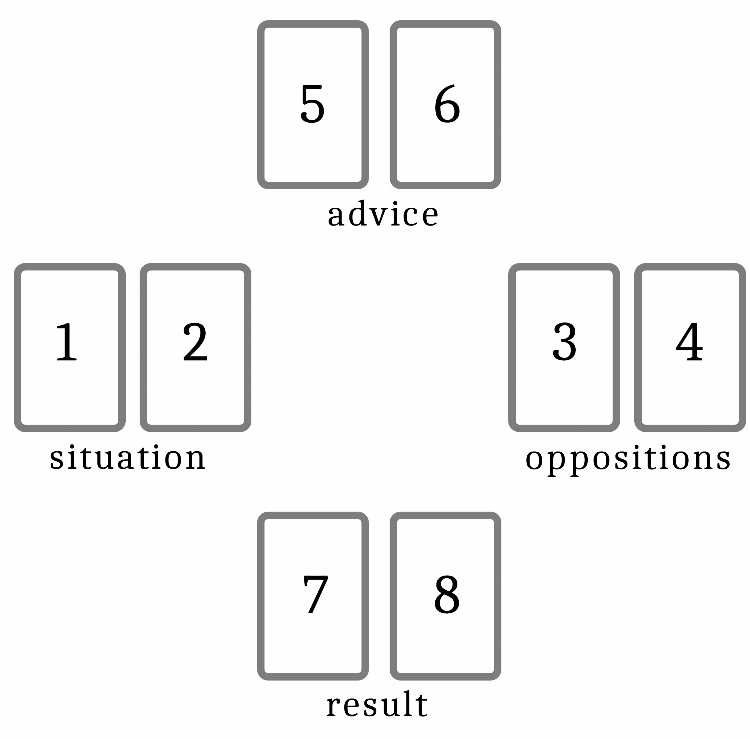
The Cross spread is a safe bet in France. Even if there are several variants, the base remains the same with 4 cards: situation, oppositions, advice, result. Some cartomancers add, for example, a synthesis card in the centre. Here, I stay with the simple version with 4 slots. As for the previous draws, you will not be surprised to see that I double each slot. The spread proceeds as follows :

  • First, the consultant draws two cards that represent his/her situation : What is his/her state of mind ? What is the real issue ? What are the pros ? Who is the consultant really ?
  • Then the consultant draws two cards on the oppositions : Where is the blockage ? What are the problems, the dilemma, the disadvantages, the cons ? What is hidden ?
  • The consultant draws two complementary cards for counselling : What awareness is needed ? What outside help is needed ? What is the best way, the middle way or the way of compromise ?
  • Finally, the consultant draws two final cards about the outcome : What is the possible outcome if the advice is followed ? What will be the response ? What consequences can be expected ?
CONCLUSION

I hope that these draws above will allow you to easily begin the Petit Lenormand by relying on a slot method and your eventual Tarot experience. I also invite you to move away from these same draws to learn the Lenormand with non-slot draws of which the most complete method is the "Grand Tableau". The practice of the "Grand Tableau" should be your goal in the long run, without saying that this method should be exclusive. Of course, slot draws with Le Lenormand can be very satisfying.

The YES/NO spread is the subject of a separate article, which you can read here: The YES/NO Spread with the Petit Lenormand

Learning the Petit Lenormand :

To go further, continue your reading with ...

Comments

Subscribe to the newsletter :