WhatsApp

Learn the Houses of the Petit Lenormand: Complete Guide for Beginners and Practitioners

alternative
INTRODUCTION

In our previous article, we explored the basics of interpreting the Petit Lenormand by focusing on combining 3 to 5 cards. This approach allows you to associate meanings for nuanced and precise answers. Today, we will delve deeper into this method by addressing a key concept: the Houses in the Grand Tableau.

The Houses represent a new way to enrich your readings by adding an extra dimension to card interpretation. If you've understood how to combine cards, the Houses will allow you to add even more depth to your readings by modifying the meaning of the cards according to their position in the spread.

In this article, I will explain what the Houses are, how they work, and most importantly, how to incorporate them into your readings to refine your interpretations. If you’re ready to take your Petit Lenormand practice to the next level, the Houses are a natural and logical step to explore.
Haut

The Houses: What Are They?

The Houses: What Are They?

When you start learning the Petit Lenormand, you will quickly hear about the Houses. But be careful not to confuse them with other concepts like astrological Houses or positions in tarot. Here, the Houses are specific positions used in a very particular spread called the Grand Tableau.

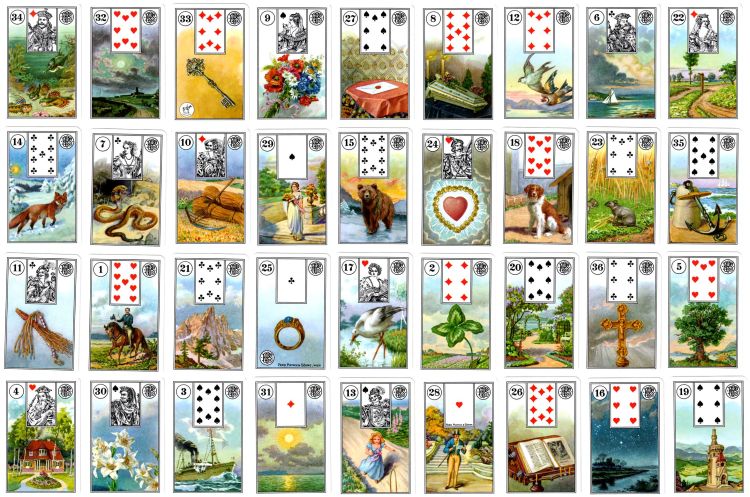
In this spread, the 36 Petit Lenormand cards are arranged on a grid of 4 rows and 9 columns (or 4 rows of 8 columns with an extra row of 4 cards at the bottom). Each position in this grid corresponds to a House, numbered from 1 to 36. Each number is associated with a specific card in the deck’s order. For example, the first House is linked to the Rider (card number 1), and the last House, number 36, corresponds to the Cross.

But what does this mean for you? Imagine each House as a space in a board game: each has its own role and can influence the card placed in it. For example, if the Fox card falls into the Rider’s House (position 1), this combination brings a nuanced message, as the House influences the card placed in it.

In other words, the Houses help you give more depth to card interpretation. Instead of simply reading a card in isolation, you take into account where it falls and the meaning of that position. This enriches your readings and allows for a more precise interpretation.

Haut

The Usefulness of the Houses in the Grand Tableau

The Usefulness of the Houses in the Grand Tableau

One of the main questions people ask when discovering the Houses in Petit Lenormand is: what exactly are they for?

In a Grand Tableau reading, the Houses add an extra layer of interpretation to each card. In fact, each House acts as a sort of modifier for the card that is "in its home." You can think of the House as a context or an atmosphere that influences the message of the card.

For example, let’s say the Moon card is in the House of the Rider (position 1). Here, the Moon often represents emotions, creativity, or recognition. If it lands in the House of the Rider, this position may indicate that these emotions or this need for recognition is coming quickly or is in motion, as the Rider is linked to speed and news.

The Houses help structure and refine your readings, a bit like when you combine two cards in a classic reading. The card is the main subject, and the House becomes an adjective or nuance that slightly modifies the message. This helps you dive deeper into the interpretation without having to look at the surrounding cards.

However, using the Houses is optional. You can do a reading without considering the Houses at all, but their use enriches your readings by adding a specific framework. This makes the Grand Tableau even more powerful and detailed, especially if you’re a beginner and feel overwhelmed by the large number of cards present.

Haut

Benefits and Limits of Using the Houses

The Benefits of the Houses

Using the Houses in a Grand Tableau reading offers several benefits, especially for those looking to deepen their interpretation of Petit Lenormand.

  • 1. Structuring and Simplifying Interpretation

    The main advantage of the Houses is that they help you organize and structure your reading. Instead of getting lost in the multiple possible combinations with surrounding cards, each House provides a clear framework for the card placed there. It’s a bit like narrowing down the possibilities: you focus on a single combination, that of the card and its House, without having to wonder which of the nine surrounding cards to prioritize.
  • 2. Adding Depth to Your Readings

    By associating a card with its House, you add an extra dimension to the interpretation. Take the example of the Lady who lands in the House of the Fox (position 14). Here, the House of the Fox will tint the reading: it might suggest caution, mistrust, or strategies to adopt in a situation concerning the Lady. This nuance enriches the interpretation without needing to look for complex associations with other cards.
  • 3. Adaptability

    Another advantage is that this method doesn’t require additional knowledge. The Houses correspond to the 36 cards of Petit Lenormand, which means you don’t need to learn new symbols. You just need to know how to interpret each card in its role as a "modifier".

The Limits of the Houses

Like any method, using the Houses also has its drawbacks.

  • 1. The Need for a Visual Aid

    To fully benefit from the Houses, it’s often recommended to use a mat or support where the 36 positions are already marked. If you don’t have such support, you’ll need to memorize each position and mentally associate each location with the corresponding card, which can be challenging for a beginner.
  • 2. Limited Use in Small Readings

    The Houses are mainly used in the Grand Tableau, but in smaller spreads (such as 3 or 5-card spreads), their use feels less natural. It’s entirely possible to associate the Houses with smaller spreads, but this requires two sets of cards: one for the Houses and one for the "subject" cards. This can complicate the setup and require additional material resources.
Haut

Deep Dive: How to Combine a Card with Its House

Once you’ve understood what the Houses are in Petit Lenormand, it’s time to see how to use them in your readings. Combining a card with its House allows you to create a richer and more nuanced interpretation. But how do you do that?

  • 1. The House as an Adjective

    The simplest method is to consider the House as an adjective that modifies the card. Imagine that the House adds a color or tone to the card that is in its home. For example, if the Lady card falls in the House of the Bear (card 15), the interpretation could point to a powerful or influential woman, as the Bear is often associated with strength and leadership.

  • 2. The House as Context or Domain

    Another way to combine a card with its House is to see the House as a context or domain of interpretation. The card represents the event or the main character, and the House indicates the area where this event is taking place. For example, if the Book card (card 26) falls in the House of the Heart (card 24), it may suggest that secrets or hidden information concern the emotional or romantic sphere.

  • 3. The House as Cause or Origin

    A third approach is to view the House as the cause or origin of the event represented by the card. The card then becomes the effect or result of this cause. For example, if the Anchor card (card 35) lands in the House of the Rider (card 1), it could indicate that recent stability (the Anchor) is the result of a new opportunity or quick change (the Rider).

The Flexibility of Combinations

It’s important to note that the ways to combine a card with its House are not fixed. You can use these different approaches depending on the situation or the question being asked. The main point is to always remember that the House is not the subject of the combination. It enriches and nuances the "subject" card that’s in it.

By practicing these methods, you will gradually refine your readings and be able to create more subtle interpretations while maintaining the overall meaning of the spread.

Haut

The 36 Houses and Their Interpretations

  • House of the Rider: Speeds up events and amplifies messages, bringing dynamism to the cards it crosses.
  • House of the Clover: Adds a touch of luck or makes a negative card temporary.
  • House of the Ship: Initiates movement or takes you far, often related to travel or changes.
  • House of the House: Connects to the home, brings affection, or serves as a refuge in a situation.
  • House of the Tree: Source of knowledge or personal growth, strengthens stability and health.
  • House of the Clouds: Creates uncertainty, confusion, and misunderstandings.
  • House of the Snake: Complicates, adds ambiguity or deception to the situations represented.
  • House of the Coffin: Ends events or starts a rapid transition.
  • House of the Bouquet: Promotes success and brightens a situation, reducing negativity.
  • House of the Scythe: Makes decisions abrupt and isolates surrounding influences.
  • House of the Whip: Stirs up conflicts and latent tensions.
  • House of the Birds: Suggests rumors or vacillation, important conversations.
  • House of the Child: Adds immaturity, spontaneity, or inexperience.
  • House of the Fox: Calls for caution or distrust in situations.
  • House of the Bear: Protects but can become possessive or tempting.
  • House of the Star: Indicates a goal or aspiration, enlightens the situation.
  • House of the Stork: Represents renewal or an upcoming change.
  • House of the Dog: Adds loyalty or dependence to the situation.
  • House of the Tower: Strengthens stability or authority in the situation.
  • House of the Garden: Makes things public or prestigious.
  • House of the Mountain: Adds obstacles or delays to overcome.
  • House of the Crossroads: Causes hesitation, demands a choice, or broadens perspectives.
  • House of the Mice: Erodes, diminishes, or calls for vigilance against losses.
  • House of the Heart: Strengthens positivity and reduces negativity by bringing love.
  • House of the Ring: Solidifies commitments or partnerships.
  • House of the Book: Requires revealing a secret or learning something new.
  • House of the Letter: Requires communication, dialogue, or a message.
  • House of the Man: Emphasizes management or an active role.
  • House of the Woman: Highlights receptivity, sensitivity, or creativity.
  • House of the Lily: Purifies influences and improves situations.
  • House of the Sun: Energizes and brightens the situation, removing all negativity.
  • House of the Moon: Encourages imagination, creativity, or the unspoken.
  • House of the Key: Unlocks problems, represents the solution.
  • House of the Fish: Represents abundance or a prosperous financial situation.
  • House of the Anchor: Stabilizes and secures the situation.
  • House of the Cross: Indicates an unavoidable trial or sacrifice.
alternative
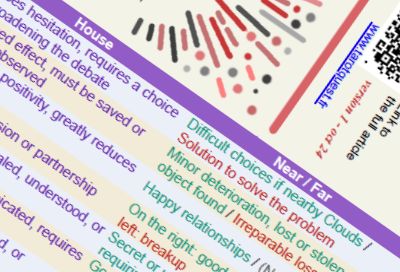
A free PDF to print, cut out, and fold!

Keywords for the Houses, to slip into your favorite deck. Your leaflet always with you, at hand, to guide you through your draws 😉 Thanks to it, your interpretations become richer and more refined 👍

Haut

Putting it into practice: Analyzing a spread

Putting it into practice: Analyzing a spread

To fully grasp the use of Houses, let's move from theory to practice with a concrete example. Let's imagine a love spread to answer the following question:

"We've been together for a year, there are ups and downs, what is the future of my relationship with my current girlfriend?"

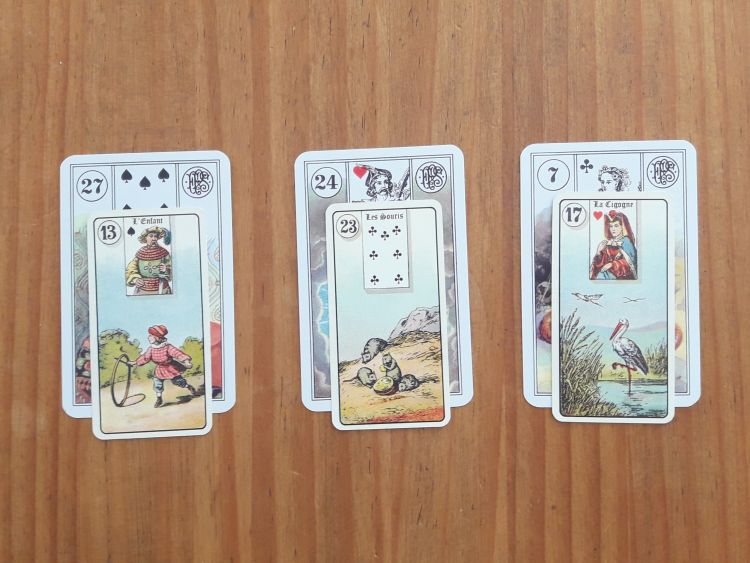
Here is the spread done with the Mobile Houses method (cards placed on defined positions):

  • Position 1 (The Partner):
    Card drawn: The Child (13) placed on the House of the Letter (27).
  • Position 2 (The Relationship):
    Card drawn: The Mice (23) placed on the House of the Heart (24).
  • Position 3 (You):
    Card drawn: The Stork (17) placed on the House of the Snake (7).

Let's now analyze these three pairs using, for each one, a different association method to show you the richness of possibilities.

1. The Partner: The Child (13) in House Letter (27)

Method applied: The House as Context

  • The card (Subject): The Child suggests immaturity, beginning, carelessness or play.
  • The House (Context): The House of the Letter (27) creates a context of communication, writings, news to be shared.
  • Interpretation: The somewhat immature or light attitude of your partner (Child) cannot remain without explanations. The context requires putting words to it. It is necessary to start a dialogue about this "childish" behavior.

2. The Relationship: The Mice (23) in House Heart (24)

Method applied: The House as Adjective (Modifier)

  • The card (Subject): The Mice signal stress, a loss, a slow nibbling away, worry.
  • The House (Modifier): The House of the Heart (24) is the seat of love and emotions. Here, it acts as a kind adjective that "colors" the Mice.
  • Interpretation: There is undeniably wear and stress in this relationship (Mice), but the presence of the House of the Heart softens the verdict. Affection remains present and reduces the negativity of the Mice. This is a stressful period, but cushioned by real feelings.

3. You: The Stork (17) in House Snake (7)

Method applied: The House as Cause or Origin

  • The card (Subject): The Stork represents your desire for change, movement, or displacement.
  • The House (Cause): The House of the Snake (7) symbolizes complications, detours, strategy, even betrayal.
  • Interpretation: Here, we use the House to explain the "why" of your card. Why do you desire this change (Stork)? Because there is a complex or vicious situation (Snake) at the origin. You want to move because of the current complications. The change here is a reaction to get out of a toxic situation.

Important note: How to choose the right method?
You may wonder: "When should I use the House as cause, and when as adjective?"
The answer is personal and intuitive. There is no rigid rule. Facing a spread, mentally test the different approaches. Which one resonates most with the story that is emerging?
If you hesitate, don't be afraid to offer the different possibilities to your querent. For example: "I sense that you want change (Stork). Is it because the situation has become too complicated (House Snake as cause) or do you feel that this change will be difficult to put in place (House Snake as adjective)?"
Often, it is the querent who will validate the most accurate nuance.


Summary of the spread

By combining this information, you can tell the querent: "Your partner lacks maturity, which requires a real discussion (Child + Letter). Although this causes you worry and wears down the relationship, there remains love that protects the couple (Mice + Heart). However, on your side, you are considering a change or a move specifically to escape these complications that have become too twisted to handle (Stork + Snake)."

Haut

Common Mistakes to Avoid

Learning the Houses in Petit Lenormand can be simple and rewarding, but some mistakes are common, especially for beginners. To help you progress without stumbling, here are the most frequent pitfalls to avoid.

  • 1. Confusing the Houses with other concepts

    It is essential not to confuse the Houses in Petit Lenormand with other systems like astrological Houses. In the context of Petit Lenormand, the Houses are simply the fixed positions of the Grand Tableau, each associated with a specific card. They have nothing to do with planetary cycles or astrological influences.

  • 2. Not considering the House as a modifier

    A common mistake is wanting to interpret the House as the subject. Remember, the card placed on the House is always the "Subject" card. The House only modifies the interpretation by adding an extra nuance. Keep this distinction in mind to avoid confusing the reading.

  • 3. Sticking to just one method of interpretation

    It’s easy to fall into the habit of using just one method to combine the cards with their Houses (like seeing the House only as an adjective). However, the Houses can offer several levels of interpretation: context, cause, effect, etc. Don’t limit yourself and explore different approaches to enrich your readings.

  • 4. Not practicing enough

    Using the Houses may seem complex at first, but the key is practice. Don’t expect to master this aspect of Petit Lenormand overnight. Do regular spreads, try different combinations, and take the time to analyze each reading. Over time, you will become more comfortable.
CONCLUSION

The use of Houses in the Petit Lenormand is a simple method to enrich your readings and add extra nuances to your interpretations. Although not mandatory, it offers a more structured approach and helps better understand the interaction between cards. Whether you choose to use them in the context of the Grand Tableau or in smaller spreads, the Houses provide new perspectives on your readings.

However, as with any practice, the key lies in experimentation and perseverance. By practicing regularly and taking the time to familiarize yourself with these associations, you will see your intuition sharpen, and your interpretations gain depth.

Remember, the Petit Lenormand is a tool for personal exploration, and using the Houses will help you enrich your connection with the cards while staying true to your own interpretation style.

Keep practicing, stay curious, and you will discover how this method can open new doors in your understanding of the Petit Lenormand.

To further your exploration of the Petit Lenormand, I invite you to read my next article, where we will delve deeper into the use of colors and card values.

[✊ Learn Petit Lenormand : Using colors and card values (3/7) ! ✊]

To go further, continue your reading with ...

Comments

Subscribe to the newsletter :